Bradshaw House at Patchett's Grove
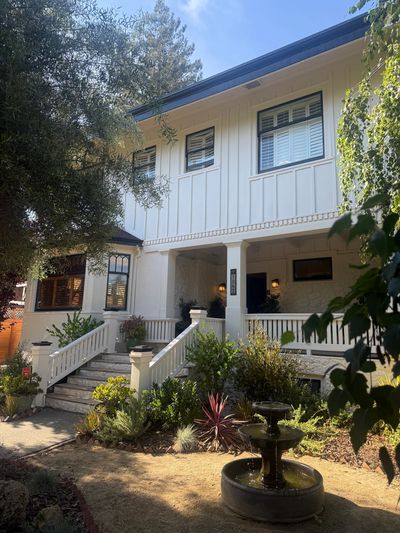
A Fully Realized Expression of Arts & Crafts Craftsmanship within the American Foursquare Form
SEE MORE PHOTOS BELOW THE ARTICLE.
Constructed circa 1910, The Bradshaw House at Patchett’s Grove stands as a vibrant and remarkably intact expression of the American Arts & Crafts movement, thoughtfully composed within the balanced proportions of an American Foursquare design. It is a home shaped by a philosophy—one that valued craftsmanship over ornament, natural materials over excess, and livability over formality.
From the moment one approaches the house, its quiet confidence becomes apparent. The structure is grounded and symmetrical, yet softened by its broad porch, layered textures, and surrounding landscape. It feels less like an object placed on the land and more like something that has settled into it over time.
A House Built in Wood, Light, and Proportion
Inside, the home reveals itself gradually, with each space connected through a continuous and carefully executed architectural language.
Walls are wrapped in paneled wainscoting that rises to meet soft, warm plaster tones above. Substantial window and door casings frame each opening with intention. Picture rails trace a consistent horizontal line through the rooms, reinforcing the geometry of the structure while offering a practical nod to the period’s design sensibilities.
The woodwork—rich, warm, and quietly expressive—serves as the unifying element throughout. It is not decorative in the modern sense; rather, it is structural, tactile, and deeply human. One becomes aware of the hand behind the work: the joinery, the proportions, the way each element meets the next without interruption.
The Living Room: Warmth, Depth, and Gathering
At the heart of the home, the living room unfolds as both a visual and social anchor.
Here, the architecture gathers itself—paneled walls, built-in cabinetry, and a substantial fireplace combine to create a space that feels grounded and enduring. The hearth is not merely a feature but a focal point, framed by a deeply profiled mantel and flanked by integrated shelving that invites both display and daily use.
Light enters through divided and leaded glass windows, softened by the geometry of their panes. The effect is gentle rather than dramatic, casting a quiet glow across wood surfaces and textiles. The room encourages pause—conversation, reading, music—rather than spectacle.
Even as furnishings change over time, the room’s character remains constant. It is defined by its architecture, not dependent on its contents.
The Dining Room: Structure and Ceremony
Moving into the dining room, the architectural language continues with a slightly more formal tone.
Full wall paneling creates a sense of enclosure and intimacy, while built-in cabinetry provides both function and visual weight. The room is proportioned for gathering—large enough to accommodate extended tables and shared meals, yet scaled to feel personal rather than grand.
There is a rhythm here: vertical panels, horizontal rails, the repetition of window divisions. It is a space that naturally organizes itself, offering a quiet sense of order that makes it equally suited to everyday use or more deliberate occasions.
The Kitchen: Continuity Through Time
The kitchen reflects a thoughtful evolution rather than a departure.
Updated for modern living, it nonetheless remains firmly rooted in the home’s architectural vocabulary. A coffered ceiling introduces depth and structure overhead, echoing the craftsmanship found elsewhere in the house. Cabinetry aligns with the warmth and tone of the original woodwork, and the central island provides a natural gathering point without overwhelming the space.
Adjacent to the kitchen, a built-in breakfast nook offers a more intimate setting—morning light, simple meals, conversation. It is exactly the kind of space the Arts & Crafts movement celebrated: functional, comfortable, and human in scale.
Private Rooms: Calm, Light, and Simplicity
Upstairs, the private rooms continue the home’s disciplined approach to design.
Bedrooms are generous yet restrained, defined by high ceilings, consistent trim, and an abundance of natural light. Wainscoting and picture rails carry through, maintaining continuity with the main level while allowing the spaces to feel lighter and more personal.
There is a notable absence of excess. These rooms do not rely on ornament; instead, they are shaped by proportion, material, and light. The result is a sense of calm that feels both intentional and enduring.
Baths: A Respectful Dialogue with the Past
Bathrooms within the home reflect a careful balance between period sensibility and modern function.
Tilework—hexagonal floors, restrained wall patterns, and subtle borders—references traditional forms without imitation. Fixtures are simple and well-proportioned, allowing the materials and layout to carry the visual weight.
They feel appropriate to the house—neither frozen in time nor disconnected from it.
Threshold Spaces: Hallways, Transitions, and Detail
Even the transitional spaces reveal attention to detail.
Hallways are not merely passages but composed environments—paneled walls, carefully placed openings, and consistent trim create continuity from room to room. Light is managed thoughtfully, often drawn from windows at the ends of corridors, creating depth and direction.
These are the spaces where the house quietly demonstrates its discipline—nothing abrupt, nothing unresolved.
Indoor–Outdoor Living: Extending the Architecture
At the rear of the property, the house opens outward, and the architectural language expands into the landscape.
A timber-framed pergola creates a covered outdoor room, defined by exposed beams, filtered light, and a sense of enclosure without walls. It functions as a natural extension of the interior—furnished, lived in, and integrated into daily life.
Beyond, the garden unfolds as a series of purposeful spaces: areas for dining, gathering, and quiet retreat. Long tables, seating areas, and pathways suggest use rather than display. The design is not ornamental but experiential—meant to be inhabited.
The relationship between house and garden feels continuous. One moves between them without transition, as though they were conceived together from the beginning.
A Cohesive Whole
What ultimately defines The Bradshaw House is not any single feature, but the consistency of its vision.
- Materials are used with intention and restraint
- Spaces relate logically and gracefully to one another
- Craftsmanship is evident without being overstated
- Updates respect the original structure rather than competing with it
The house remains legible as a complete work—one in which architecture, material, and daily life are aligned.
Enduring Character
More than a century after its construction, the home continues to express the principles that shaped it:
- Simplicity without austerity
- Warmth without excess
- Craftsmanship without display
- And a deep, enduring sense of place
It is a house that does not need to be explained to be understood—only experienced.